
South Asia’s looted treasures – on their way home?
Updated: Apr 2
Camilla Orjuela | 12 February 2026

Many people want to see the British Crown Jewels, and a long queue winds its way across the courtyard cobblestones at the Tower of London. The gem-encrusted treasures are a tourist magnet, drawing millions of visitors each year. They are also important symbols of Britain as a nation and of its royal family. At coronations, the extravagantly decorated crowns, scepter and orb have a ceremonial, almost sacred, role in transferring power, dignity and responsibility to the new monarch.
At the same time, the objects have a complicated history, and it is not entirely obvious that they belong in London. Most controversial is the legendary Koh-i-Noor diamond that adorns one of the crowns. Once inside the Tower’s dark and well-guarded exhibition halls, visitors are presented with information about the large gemstone. A slideshow explains that the Koh-i-Noor – “mountain of light” in Persian – was found in a mine in southern India several hundred years ago only to become a centerpiece of battles and conquests over the years. From southern India, it came in the hands of Mughal emperors, from where it was taken as a spoil of war to present-day Iran by Nader Shah in 1739. It was then given to the Durrani Empire of Afghanistan, before coming into the possession of Maharaja Ranjit Singh and the Sikh Empire in 1813. When the British defeated the Sikhs, Ranjit Singh’s son, ten-year-old Maharaja Duleep Singh, was forced to hand over the diamond to Queen Victoria in accordance with a 1849 treaty that also gave the British control of the Punjab.

Once in London, the diamond was put on public display at the Great Exhibition of 1851. The audience’s lack of enthusiasm sparked the initiative to recut it to give it a more impressive luster. The Koh-i-Noor was worn by Queen Victoria as a brooch and eventually found its current place in a crown used at the 1937 coronation of Elizabeth the Queen Mother. Inside the Tower, visitors step onto a moving walkway that slowly takes them past the Crown Jewels. In the very last glass case, the crown with the Koh-i-Noor is placed. At the coronation of King Charles and Queen Camilla in May 2023, South African diamonds adorned Camilla’s crown – it was considered too sensitive to use the Koh-i-Noor, which had come to represent colonial conquest.
Since independence in 1947, India has demanded the return of the gemstone. Although the Koh-i-Noor has long since left the country, many see it as an important part of Indian cultural heritage. It appears in films, novels and poetry, has given its name to countless restaurants and appears in linguistic expressions. For example, someone might lovingly say “You are my Koh-i-Noor”, while a person who has lost something can be comforted with “At least it wasn’t the Koh-i-Noor”. There is also anger that the diamond – just like numerous other Indian cultural treasures – has been brought to and remains in Britain, the former colonial power.
Despite repeated demands and attempts to take the matter to court, it seems highly unlikely that the Koh-i-Noor will be returned. Not least because, with its place among the Crown Jewels, it is important part of British tradition and culture too. Furthermore, it is not only India that has asked to get the Koh-i-Noor back. Pakistani leaders have also laid claim to it, as it last belonged to the Sikh Empire, with its seat in Lahore in what is now Pakistan. The Taliban in Afghanistan and the government of Iran have, as well, requested that the Koh-i-Noor be returned to them.

Aside from that, the restitution of objects that were looted or otherwise removed during the colonial era is a growing trend, and something pursued by both states and activists. For instance, the Black Lives Matter movement, which in 2020 mobilized on mass against police violence, also demanded that cultural objects be returned to the former colonies. Some activists have taken matters into their own hands and simply entered museums to take objects out – a way of using civil disobedience to highlight the injustice of stolen objects still remaining in the institutions of former colonial powers. Politicians, museum staff and academics have also advocated restitution as part of a larger process of coming to terms with colonial legacies. In a notable speech in Burkina Faso in 2017, President Emanuel Macron announced that France intended to return cultural treasures it had taken from its African colonies. Restitution processes have also been initiated in Germany, the Netherlands and Sweden.
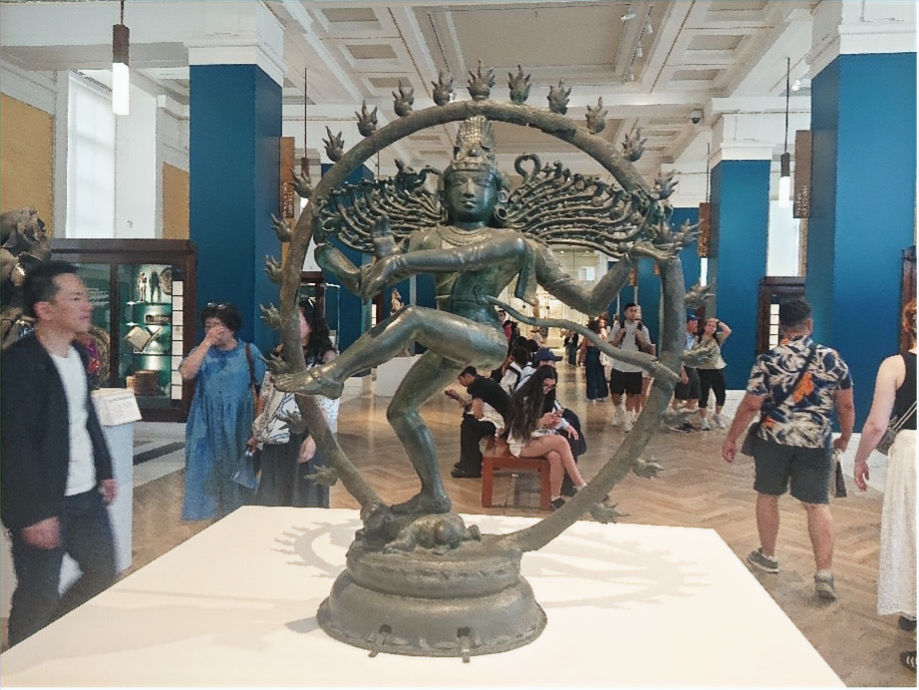
One institution that has received numerous demands, but which has so far tended to refuse returns, is the British Museum. This grand building in central London is a palace of historical treasures from all over the world. Room 33 features items from South Asia and a large sculpture of a dancing god Shiva, a so-called Nataraja, is placed in the middle of the floor at the entrance to the exhibition. In the vast hall, history is presented chronologically, divided into different civilizations. People from all corners of the globe – Londoners and tourists – stream through. Some read the explanatory texts carefully, while others look more cursory. The South Asian artefacts do not draw as large crowds as the Parthenon sculptures from ancient Greece or the Egyptian mummies that are housed in other parts of the museum. But they are nonetheless invaluable. Among them are, for example, remains from one of India’s oldest and most significant Buddhist temple complexes, Amaravati, from the centuries before Christ – mighty stone sections, intricately sculpted with scenes from the life of the Buddha.

A considerable number of objects in the South Asia exhibition are religious. The information signs sometimes mention that the sculptures previously belonged to temples. From having decorated a religious site or embodied a god or goddess and been worshipped by people, they have instead become exhibits admired as skillfully executed works of art. For many of the museum visitors, they represent cultures that are distant and foreign. Others recognize them. “There you see!” exclaims a young girl with a veil to her friends. She has just found a text that confirms that some sculptures she felt were familiar are indeed from Afghanistan, the country her relatives are from. Another visitor puts his hands together in a gesture of reverence before one of the large Hindu deities.
When the South Asia exhibition was redesigned in 2017, Britain’s colonization was given some consideration, as was the resistance to it. But the question of returning objects that had come to the UK as loot, war booty, or traded or gifted under unequal conditions, remain unaddressed. The forces opposing their restitution are strong. Laws in Britain and several other countries prevent museums from giving up their collections, and many powerholders argue (sometimes wrongly) that the countries of origin lack resources and knowledge to preserve the ancient and often fragile artefacts.
However, some activists have challenged the British Museum’s silence on restitution. In 2018, the India Pride Project carried out a captivating campaign – they entered Room 33 and held up what looked like speech bubbles next to some of the statues, while taking photos of them. The large Nataraja, for example, appears to be saying “Help!!! The Brits have kidnapped me!”. “How did I get here?”, asks a Buddha figure, while another sculpture says: “I’m a deity, not a showpiece.” The images went viral on social media, drawing attention to questions of ownership and colonial guilt.
The India Pride Project works for the return to India of stolen deities that have ended up in museums and private collections around the world. They argue that India’s cultural treasures have been plundered for centuries – first by the Mughals, who ruled over large parts of the Indian subcontinent between 1526 and 1857, and then by European colonizers, most notably Britain. After independence, the country’s own inhabitants have engaged in thefts from temples to satisfy the desire of Western museums and private collectors for exotic art – something that is still ongoing. To get the looted gods back is to regain India’s pride, according to the organization.
Since coming to power in 2014, India’s ruling Bharatiya Janata Party, BJP, has made the return of cultural artefacts an important foreign policy ambition, and the number of returns has increased significantly. This has, obviously, been welcomed as an important achievement. At the same time, it is part of the BJP’s Hindu nationalist project, where the portrayal of the Mughals as occupiers is used to depict the country’s Muslims as alien. Both the BJP and the India Pride Project focus on bringing back Hindu and Buddhist items but show less interest in the country’s Muslim and Sikh heritage. In India, there is a tension between the idea of “unity in diversity” – that the country consists of people of various languages, religions and cultural traditions who live together in harmony – and the Hindu nationalist currents that see India as primarily Hindu.
Disputed cultural objects can, in fact, serve a variety of nationalist purposes. The Koh-i-Noor, for example, is often seen as a national symbol of India, but can also be linked to the Sikhs as a group. In addition, many in Britain view the Koh-i-Noor and other objects from the former colonies as British. Although the country has begun to come to terms with its violent history as a colonial power, many Britons consider the imperial era a source of pride. In contrast to various nationalist tendencies, there are others still who see the historical artefacts as a world heritage that belongs to humanity rather than to a particular country or people.
When one of the deities, with assistance from India Pride Project’s speech bubble, says “I belong to my people”, questions may arise about who and where this people actually are. As gemstones, sculptures and other cultural treasures have moved between places throughout history, so have humans as well. This is particularly evident in a diverse and cosmopolitan city like London. Of Britain’s approximately 70 million inhabitants, nearly five million stated in the latest census that they are of South Asian descent. Some of the heirs to the kingdoms and societies that once lost their cultural artefacts thus live in the countries that were responsible for the colonial plunder. Determining where historical treasures belong is not easy in a globalized world.
Precisely the diaspora plays a central role in Manchester Museum's South Asia gallery, which opened in 2023. The exhibition was jointly planned by the museum and 30 people of South Asian heritage – artists, musicians, historians, teachers and community leaders. The resulting exhibit combines ancient and everyday objects to tell stories of the region and its people. A colorful mural of the Singh Twins, two British-born women of Sikh descent, takes center stage and provides a commentary on British colonial history and the experience of South Asians in the diaspora. The Koh-i-Noor itself appears in the painting, in Queen Mary's crown. In a large self-portrait, Azraa Motala challenges the stereotypical image of the South Asian, Muslim woman and shows that identities are mixed and in constant flux. The Indian magazine Vogue describes the gallery as a successful attempt to begin healing the wounds inflicted by British imperialism. “Growing up in Manchester, we didn’t have something like this, the South Asia Gallery, so it’s quite emotive to come in here and see myself represented and then now to be part of that and bring some artwork here”, artist Nasia Salwar-Skuse says. Her installation invites visitors to step into history in the form of a recreated tent that once belonged to Mysore’s legendary Sultan Tipu, but which was looted by British forces in 1799.

Another co-creator of the South Asia Gallery, Nazma Noor, describes her conflicting feelings when seeing historical objects from South Asia on display in the UK. She appreciates not having to travel all the way to India or Pakistan to see them but is aware of their potentially dark history. “Why does the museum really own them?” she asks, showing her favorite object, a 1930s brooch adorned with a stunning emerald from the Mughal era. How the gem ended up in Europe is unknown.
Collaborations with people from the countries where their collections originate have become a way for museums to deal with their past as institutions of power and to allow more voices to be heard. While processes of decolonization of museums are underway in the West, new exhibitions are opening in the Global South with recently returned objects. In January 2026, Prime Minister Modi inaugurated an exhibition in Delhi of precious stones believed to have belonged to the Buddha. Taken by a British archaeologist during an excavation in 1898, they have now been bought back to India through a partnership between the government and a business conglomerate.
The return of religious and historical objects can be of great significance for powerholders, ordinary people as well as for how history is understood. In Sri Lanka, it was a major occurrence when a royal gold-plated throne was brought back in 1934. Britain had taken it as a spoil of war when defeating the King of Kandy and taking control of the island in 1815. Large crowds came to see the throne in the 1930s and today it occupies a central place in the country’s National Museum. Although it was originally a gift from the Dutch and combines Sri Lankan, Indian and European styles, it developed into an important symbol of the nation and the majority Sinhalese, and contributed to constructing the Kandy kingdom as a representative of pure and original Sinhalese culture.
The newest additions to the museum in Colombo are six objects that were returned in 2023 from the Netherlands, Sri Lanka’s colonial masters during the 17th and 18th centuries. The ornate and ceremonial weapons – including a cannon, two swords and a knife – were looted from Kandy in 1765 and subsequently exhibited at the Rijksmuseum in Amsterdam. Along with Germany, the Netherlands has over the past decade been at the forefront of restitution, following mounting pressure from academics, members of the diaspora and politicians. The void created in the exhibition at the museum in Amsterdam has been filled with new objects made by Sri Lankan artists and artisans, while the weapons have received a prominent place in the exhibition in Colombo, for the benefit of Sri Lankans and visitors.
However, some Sri Lankans express skepticism about the return of historical treasures – in their view, it is only thanks to them being looted that the objects have been preserved. According to their experience, the country’s rulers do not always manage their power well. At the time of the return process, Sri Lanka experienced its worst economic crisis since independence. Massive popular protests in 2022 accused leading politicians of stealing from the people. When objects that came to Europe in questionable ways during the colonial era are being brought back home, uncertainty still prevails about how they will be taken care of and what purposes they will come to serve.
Notably, Nepal has put local communities in focus when stolen artefacts are returned. The country was never colonized and for a long time it was closed off from the outside world. In the 1950s, when Nepal opened up to tourism, this paved the way for looting from the country’s many temples. Priceless gods were simply removed, carried away and sold illegally to different parts of the world. Thanks to a group of enthusiasts who started a campaign to track down the deities and try to get them back, several have been returned. Once in Nepal, museums are not seen as their rightful home, since the statues are not works of art and historical treasures, but a living cultural heritage. Local people regard them as gods who have taken physical form, and they venerate them by washing and decorating them and offering them food. Thus, they belong in the local temples from which they were stolen. To be able to bring them back there, researchers Kristin Hausler and Elke Selter point out, it is necessary to protect them from new thefts as well as damage and corrosion. But the most important condition is that they are worshipped. During ceremonies, people often beautify the deities using vermilion, a red pigment which can wear down the material they are made of. But, many believe, it is better for the gods to be put to work than to be locked up in museums or collections far from the people who admire them.
The debate over looted cultural artifacts is certainly alive today, both in different parts of South Asia and in the diaspora. Questions about where the objects belong can have multiple and sometimes contradictory answers. The discussion about ownership, colonial legacy and contemporary power struggles is likely to continue well into the future.
Camilla Orjuela is a professor at the School of Global Studies, University of Gothenburg, and leads the research project People, Places and Plunder: Diasporas and the Restitution of Looted Heritage. A Swedish version of this article has been published by Sydasien.


